Imagine a device that can silently stop someone mid-sentence from across the room—no shouting, no arguing, just a subtle technological nudge. That's exactly what the speech jammer project by [Blytical] aims to achieve. While it may seem like a passive-aggressive way to tell someone to be quiet, the engineering behind it is both fascinating and educational. More importantly, the journey to building it reveals critical lessons about hardware design and the dangers of blindly copying reference circuits.
How Delayed Auditory Feedback Works
The core principle behind the speech jammer is delayed auditory feedback (DAF). When a person hears their own voice played back with a short delay—typically between 50 and 200 milliseconds—it creates a jarring cognitive dissonance that makes it extremely difficult to continue speaking. This effect is so powerful that it can cause stammering, repetition, or complete speech disruption.
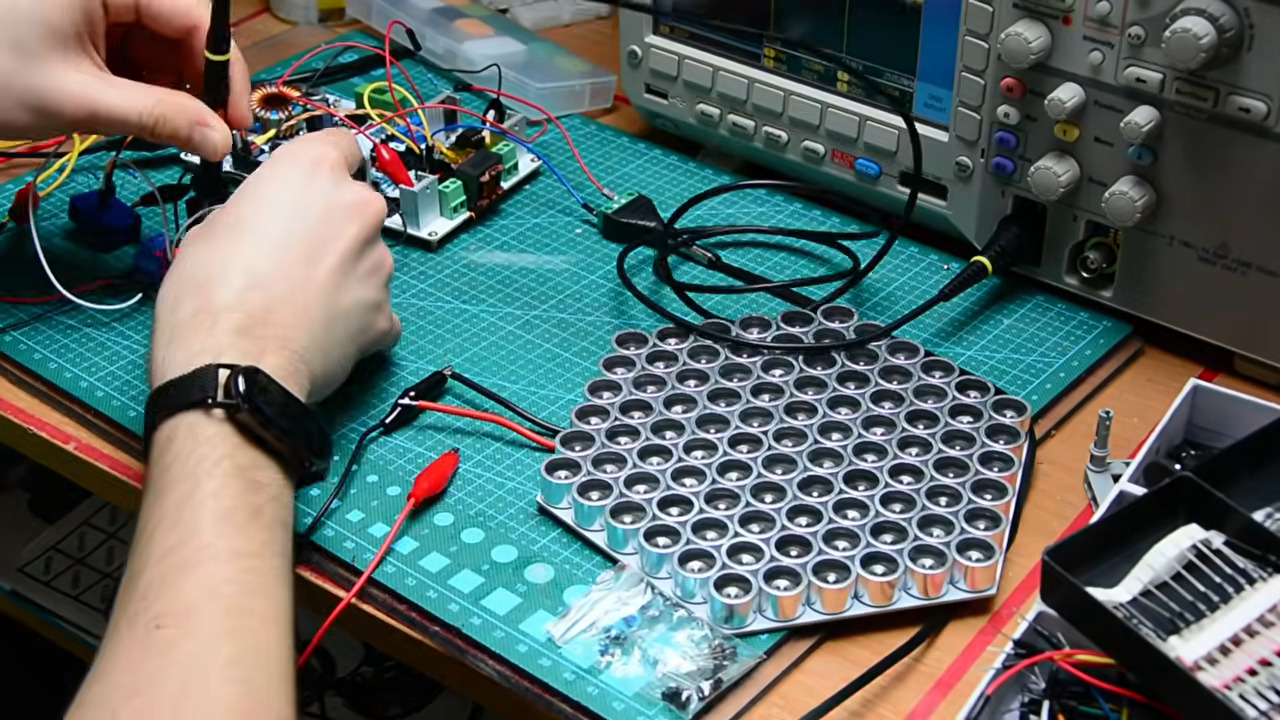
To achieve this, the device uses a shotgun microphone to capture the target's voice. The audio signal is then processed through a delay circuit and transmitted back toward the speaker via an array of ultrasonic transducers. These transducers emit an inaudible carrier wave that modulates the delayed audio, allowing it to be focused and aimed precisely at a single person.
The Ultrasonic Carrier and Aiming
Ultrasonic transducers are key to the speech jammer's stealthy operation. Because humans can't hear the ultrasonic carrier, the delayed audio seems to come from nowhere—a perfect psychological trick. The same technique has been used in other projects, such as directional loudspeakers, to project sound to a specific spot without disturbing others nearby.
In [Blytical]'s build, the microphone picks up the target's speech, the delay circuit introduces the lag, and the ultrasonic array beams the result back. Theoretically, this should cause the speaker to stumble over their words within seconds. However, theory and practice don't always align, as the builder soon discovered.
Common Pitfalls in Hardware Implementation
[Blytical] openly admits that he rushed the design by copying reference implementations from datasheets without fully understanding the layout choices. This approach—dubbed "datasheet-level vibe coding"—can work perfectly sometimes, but more often it leads to hours of frustrating troubleshooting.
The main trouble was in the audio processing circuitry. The delay element, which could have been implemented easily in software (for instance, using a Raspberry Pi), became a hardware nightmare when ported to a custom PCB. Small layout mistakes—like incorrect trace lengths, improper grounding, or mismatched impedances—can cause noise, distortion, or complete signal failure.
Rather than retreating to a software solution, [Blytical] chose to push through the hardware difficulties. This decision, while risky, turned into a valuable learning experience. As he notes, "You learn a lot more when you bite off more than you can chew." For anyone considering a similar project, the lesson is clear: study the datasheet beyond the schematic. Understand why components are placed where they are, and simulate critical paths before committing to a PCB.
Lessons from the Build
Despite the setbacks, the project isn't a failure. The ultrasonic array portion works well—that part of the design is solved. The remaining challenge is to perfect the delay circuit. One elegant alternative, suggested by the original article, is to use a tiny tape loop. Analog tape loops can provide a fixed delay without complex electronics, though they come with their own issues (mechanical wear, alignment).
More broadly, [Blytical]'s experience highlights the importance of:
- Prototyping before PCB fabrication — breadboard or simulate critical sections first.
- Understanding trade-offs between analog and digital implementations.
- Embracing failure as a stepping stone to deeper knowledge.
Future Possibilities
It's a shame that the speech jammer hasn't been demonstrated in action yet. The concept remains tantalizing, and with a working ultrasonic array, the main barrier is the delay circuit. Perhaps another maker will take up the challenge, armed with the lessons from [Blytical]'s thorough troubleshooting. Whether as a prank, a research tool, or a psychological experiment, the speech jammer is a testament to how a simple idea—delayed auditory feedback—can inspire a complex and educational build.
For those who want to explore further, check out our guide on ultrasonic aiming or our article on how delayed auditory feedback works. And remember: sometimes the best way to learn is to build something that doesn't work the first time.